
The Contributing Factors section appears below the main chart on a company's Probability of Distress (PoD®) profile. It shows the key drivers behind the score, so you can quickly understand why a company has received its PoD® rating.
PoD® is now live. You can find it on the company profile, in Monitor alert emails, on the Portfolio Overview and through the API.
How the chart works
Each contributing factor shows how that area of the company's data affects its PoD® score.
🔴 Red (Negative contribution): the factor increases the risk.
🟢 Green (Positive contribution): the factor reduces the risk.
Each factor comes with a percentage increase or decrease. This value is the increase/decrease in the PoD® away from the base insolvency rate which is shown at the top of the chart. Factors are listed in order of impact, with the strongest at the top. Smaller drivers are grouped under 'Other factors'.
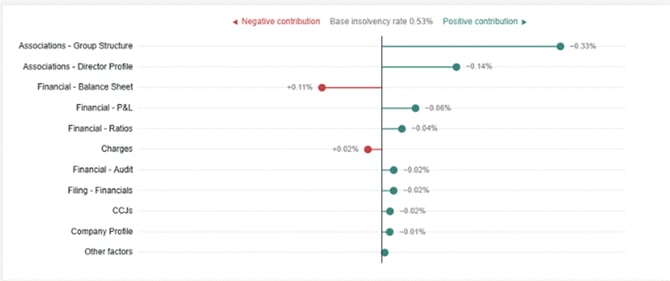
Example of the Contributing Factors chart on a company's PoD® profile
What are the Contributing Factors?
| Factor | Description |
|---|---|
|
Associations - Director Profile |
Details about the directors associated with the company, including how other companies they are or have been involved with have performed. |
|
Associations - Group Structure |
Details about the associated companies within the company's group structure, such as the financial health of these companies, as well as the relationship between the company and the wider group. |
|
Company Profile |
The basic characteristics and profile of the company, such as its SIC code, size, age etc. |
|
Filing - Address |
Filings relating to the company's registered address, such as address changes. |
|
Filing - Confirmation Statement |
The company's confirmation statement filing behaviour, including whether statements have been filed as required. |
|
Filing - Financials |
The company's financial filing behaviour, for example whether it has filed its accounts on time. |
|
Filing - Notices |
Notices filed against the company, such as strike-off notices. |
|
Financial - Audit |
The audit details for the company's most recent set of accounts. |
|
Financial - Balance Sheet |
The company's balance sheet across its most recent sets of accounts. |
|
Financial - P&L |
The company's profit and loss statement across its most recent sets of accounts. |
|
Financial - Ratios |
The company's key financial ratios across its most recent sets of accounts. Ratios help put the raw financial figures into context and make it easier to assess the company's financial health. |
|
CCJs |
County Court Judgments (CCJs) registered against the company. |
|
Charges |
The outstanding and satisfied charges against the company, such as mortgages. |
|
Unsecured Debtors |
The unsecured debtors of the company. |
|
Winding Up Petitions |
Winding Up Petitions (WUPs) filed against the company. |
|
Distress - Previous Distresses |
Any previous financial distress events the company has experienced. |
|
Other factors |
The combined effect of smaller factors not listed individually. |
Contributing Factor examples
Below are some examples of situations that can cause negative and positive contributions in each factor. Due to the nature of the model this table is the general case and does not mean that the following will be true in all cases.
|
Factor Name |
Negative contribution |
Positive contribution |
|
Associations - Director Profile |
Directors are linked with insolvent companies. |
Directors do not have a track record of insolvent companies. |
|
Associations - Group Structure |
The group contains companies that are insolvent or in poor financial health. |
The group structure is financially healthy. Having no group structure is also considered positive. |
|
Company Profile |
The company is in a volatile industry, and its age and size make insolvency more likely. |
The company is in a stable industry, and its age and size make insolvency less likely. |
|
Filing - Address |
Multiple changes of address have been detected. |
Address filings are stable. |
|
Filing - Confirmation Statement |
Confirmation statements are late or incomplete. |
Confirmation statements are timely and complete. |
|
Filing - Financials |
Financial filings are late or incomplete. |
Financial filings are complete, timely and accurate. |
|
Filing - Notices |
Strike-off notices have been issued. |
No strike-off notice has been received. |
|
Financial - Audit |
The audit report raises concerns, such as a qualified opinion or going concern issues. |
The audit report is clean and unqualified. |
|
Financial - Balance Sheet |
The balance sheet shows weak assets, high liabilities or poor financial health. |
The balance sheet shows strong assets, low liabilities and good financial health. |
|
Financial - P&L |
The company shows losses or declining profits. |
The company is profitable and shows growth over time. |
|
Financial - Ratios |
Ratios indicate poor liquidity, profitability or solvency. |
Ratios indicate strong liquidity, profitability and solvency. |
|
CCJs |
The company has County Court Judgements (CCJs). |
There are no CCJs and payment history is clean. |
|
Charges |
The company has taken out many mortgages or charges. |
No mortgages or charges have been taken out. |
|
Unsecured Debtors |
There are large amounts of unsecured debtors, or a large amount owed. |
Unsecured debt is low and manageable. |
|
Winding Up Petitions |
A Winding Up Petition (or application) has been lodged. |
No Winding Up Petitions (or applications) have been lodged. |
|
Distress - Previous Distresses |
The company has had a previous distress event |
No previous distress events for the company . |
|
Other factors |
The combined effect of smaller factors not listed individually. |
The combined effect of smaller factors not listed individually. |
Related articles