
Public Sector Contracts [BETA] is available on the Gold plan only. Interested in upgrading? Please contact support@companywatch.net, and we’ll arrange this with your Account Manager.
How to access
Via the Health Profile notification: When a company has government contracts, a “Public Sector Contracts” notification appears on the Health Profile. Click “View Public Sector Contracts” to go directly to the data.
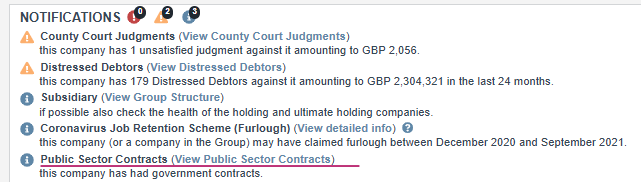
Via Company Info: Navigate to Company Info in the left-hand menu, then select Public Sector Contracts [BETA].
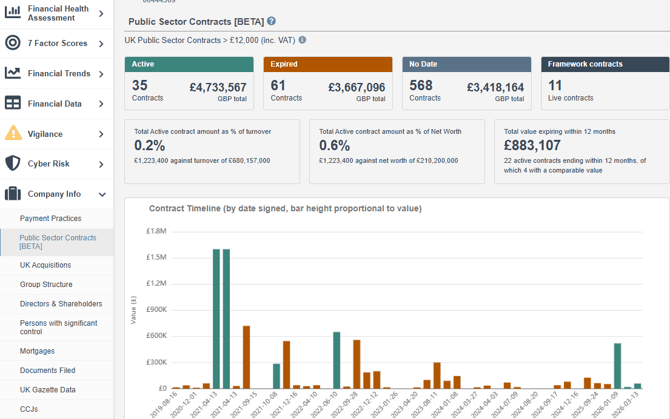
The Public Sector Contracts data brings together around 3 million procurement records published by UK public sector contracting authorities, covering tender opportunities, contract awards, and the agreements that follow. It allows you to see who is buying what, from which suppliers, at what value, and over what period.
The data is sourced from the two central UK government procurement platforms — Contracts Finder and the Find a Tender Service. Both platforms are made available under the Open Government Licence v3.0, which permits commercial reuse with appropriate attribution.
Because the information is published by hundreds of individual contracting authorities to differing standards, it should be treated as a reference record of what has been published rather than a complete or definitive register. The caveats in the Data quality and limitations section below are important when interpreting figures.
Data sources
Contracts Finder
Contracts Finder is used by all non-devolved public sector contracting authorities to publish contracts above defined thresholds — £10,000 in central government and £25,000 across the wider public sector and the NHS. It is also used by public sector contractors to advertise opportunities within their own supply chains.
Publication is a legal requirement: under regulations 106, 108, 110, and 112 of the Public Contracts Regulations 2015, contracting authorities must publish procurement opportunities and contract awards above the thresholds on Contracts Finder.
- Coverage: November 2016 onwards
- Update frequency: Real time at source
- Typical thresholds: £10,000 (central government); £25,000 (wider public sector and NHS)
Find a Tender Service (FTS)
The Find a Tender Service is the central digital platform on which UK contracting authorities publish procurement information, particularly for higher-value contracts.
On 1 January 2021, FTS replaced the EU's Tenders Electronic Daily for publishing high-value notices (generally above £118,000) in the UK's public and utilities sectors. Under the Procurement Act 2023, an enhanced version of FTS launched on 24 February 2025, integrating notice publishing, sign-in and registration, and supplier information in one platform.
For procurements started on or after that date, FTS publishes both above- and below-threshold notices for new UK procurements, with the exception of below-threshold notices in Scotland. For procurements initiated before that date, only above-threshold notices appear — typically for contracts exceeding £139,688 including VAT.
- Coverage: January 2021 onwards
- Update frequency: Real time at source
- Typical thresholds: Above c. £118,000 historically; below-threshold notices also covered for new procurements under the Procurement Act 2023 (excluding below-threshold notices in Scotland)
Which source applies
In broad terms, lower-value contracts tend to appear on Contracts Finder, while higher-value notices appear on the Find a Tender Service; many procurements are represented across both. The two platforms overlap in purpose but differ in thresholds, legal basis, and historical coverage, so a single procurement may be visible in one, the other, or both depending on its value and date.
How procurement data is structured
A procurement runs through several stages, and a record may capture some or all of them:
These stages include Planning, Tender, Award, Contract and Implementation. — early-stage information about an intended procurement before it goes to market.
Company Watch has only included the Contract stage where the agreement entered into following the award.
Not every stage is published for every procurement, and the same procurement may occasionally appear under more than one record. Suppliers and buyers are unique within a single procurement but can recur across many.
How contract status is determined
Each contract is categorised by status based on the dates and details in the published record:
- Active — The contract is within its delivery period; the start date has passed and the end date has not.
- Expired — The contract's end date has passed, so its term has concluded (unless it has been extended or replaced).
- No date — The start and/or end dates are missing from the published record, so status cannot be reliably determined.
- Framework — An agreement setting the terms under which future "call-off" contracts may be awarded; not a purchase commitment in itself, and may cover numerous suppliers under a single framework.
Status reflects the dates as published. A contract shown as expired may in practice have been extended without an updated notice, and framework status describes the overarching agreement rather than the individual call-offs placed beneath it.
Data quality and limitations
The underlying data is published by many different authorities and entered manually, so it carries quality issues that are worth understanding before relying on any single figure.
Common Issues include:
- Important fields are sometimes empty, including supplier names.
- Some date fields are unrealistic or incorrectly formatted, affecting award dates and contract period start and end dates.
- Values may be estimated, capped, or expressed over differing contract periods, and notices may be amended or withdrawn after publication.
-
- Organisation identifiers are missing for most buyers and suppliers, so organisations often have to be matched by name.
- The highest contract values include extreme outliers, and the frequent repetition of certain award values suggests some figures may be misreported.
- Some records contain non-standard characters that require cleaning during processing.
- Document format is occasionally recorded in place of document type, and some document links resolve only to internal addresses.
Because of these factors, the data should be used as a guide and cross-checked against original sources where accuracy is critical. Company Watch presents the information as published and does not guarantee its accuracy or completeness.
Company Watch has put the following rules in place to assist in interpretation:
Values
- Frameworks are excluded from value totals - a framework figure is a shared ceiling across many suppliers, not one company's award.
- Duplicated values are excluded - where the same figure is repeated across related lines, we don't add it up multiple times.
- Unverified values are excluded - for example awards published without a meaningful value.
- All values shown in GBP.
Counts
- Counts include all valid published awards, with frameworks shown separately. Records published without basic details are excluded. Counts are under ongoing review.
Status
- Contracts show as Active until the end date passes, then Expired. Renewals appear once officially published.
Currency of data
- Refreshed monthly. Awards are often published weeks or months after signing, so recent contracts may not appear straight away.
- Contracts appear where the company is named on the notice by its registered company number. Where a contract runs through a reseller or partner, it shows under that partner.
- Figures are reviewed and improved on an ongoing basis.